DigestiStart Ingredients: What’s in the Formula?
See the 11 botanical ingredients DigestiStart's manufacturer lists, what independent sources say about them, and how to read a supplement label before you buy.
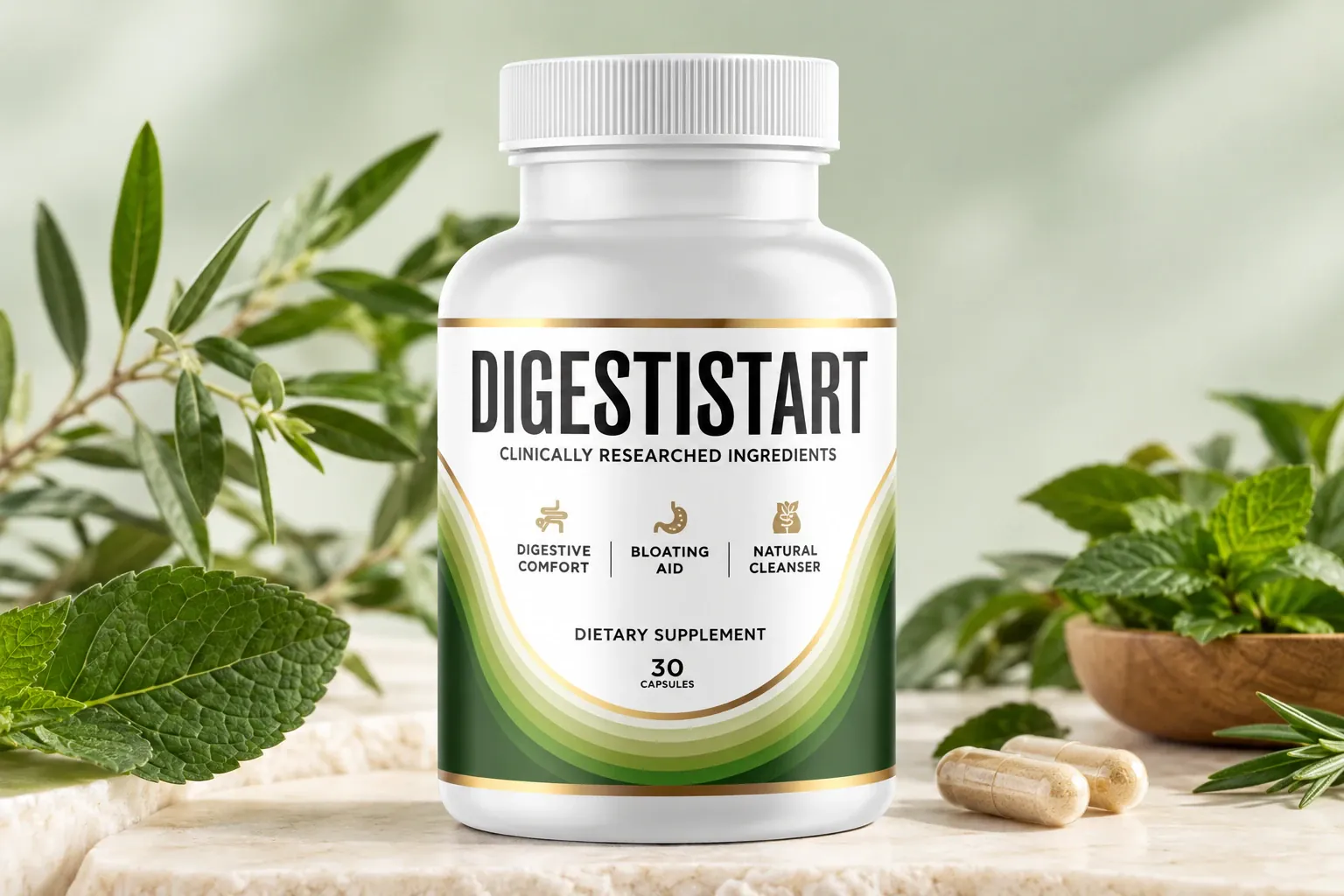
Table of contents
Looking closely at the ingredient list is one of the most useful things you can do before buying any dietary supplement. It tells you what you would actually be taking, and it gives you something concrete to research beyond the marketing.
DigestiStart is a capsule product marketed for digestive support. It is sold with the FDA disclaimer statement used for dietary supplements, and its manufacturer describes it as a blend of botanical ingredients. This article looks at the formula based primarily on the manufacturer's published product information. We also note what we could, and could not, verify in independent sources. Wellness Buyer Guide has not personally tested DigestiStart, and we are not its manufacturer or seller.
DigestiStart Ingredient List
We checked these names against the manufacturer's website, and they appear there as listed above. The website does not state how much of each ingredient the formula contains.
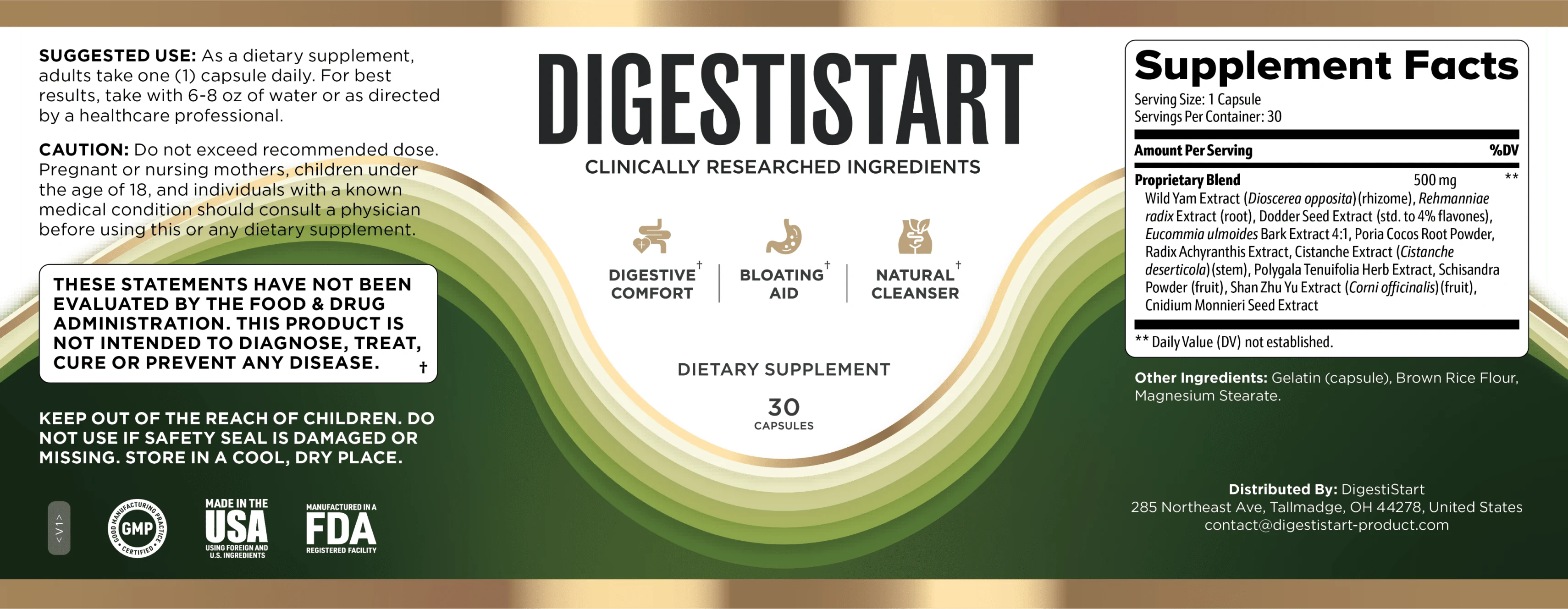
The product label provided by the manufacturer, shown below, adds more detail. Its Supplement Facts panel lists a serving size of one capsule, 30 servings per container and a 500 mg proprietary blend per serving containing the same 11 ingredients. As FDA rules allow for proprietary blends, the label gives only the total weight of the blend, not the amount of each ingredient, so we don't provide individual amounts. The label also describes the Dodder Seed Extract as "std. to 4% flavones" and the Eucommia ulmoides Bark Extract as "4:1." These are the manufacturer's descriptions, which we have not independently verified. The other ingredients listed are gelatin (capsule), brown rice flour and magnesium stearate.
 (opens the full-size image in a new tab)
A Closer Look at the Formula
The formula combines 11 botanical ingredients. Several of the names are Latin pharmaceutical names (for example, radix is Latin for "root") or Chinese names, such as Shan Zhu Yu, which reflects their association with traditional Chinese herbal practice.
For each ingredient, it helps to separate three things:
- What the manufacturer says: the manufacturer's website lists the ingredient names but does not describe what each ingredient is meant to do.
- Traditional use: how an herb has historically been used, where a reliable source documents it.
- What scientific evidence establishes: often much less than traditional use suggests.
We looked for each ingredient in two independent references: the National Center for Complementary and Integrative Health's Herbs at a Glance (opens in a new tab) and Memorial Sloan Kettering Cancer Center's About Herbs database. Here is what we found.
Wild Yam
Memorial Sloan Kettering's wild yam monograph (opens in a new tab) identifies wild yam as the root of Dioscorea species. It describes traditional uses for several purposes and characterizes the evidence as limited and mixed. It also notes that wild yam has shown estrogen-like effects in some research and advises people with hormone-sensitive cancers to talk to their physicians before using it. We found no independent evidence in these sources about wild yam's effect on digestion.
Schisandra
Memorial Sloan Kettering's schisandra monograph (opens in a new tab) describes schisandra as the fruit of Schisandra species, with a long history of use in traditional Chinese medicine. Its traditional uses include digestive complaints, among others. However, the monograph states that only a small number of human studies exist and that they are too limited to draw conclusions. It also notes that schisandra may affect how some medications work.
The Other Nine Ingredients
For Rehmanniae Radix, Dodder Seed, Eucommia Ulmoides, Poria Cocos, Radix Achyranthis, Cistanche, Polygala Tenuifolia, Shan Zhu Yu and Cnidium Monnieri, we did not find an NCCIH Herbs at a Glance fact sheet or a Memorial Sloan Kettering About Herbs monograph. Rather than rely on less reliable sources, we are not describing their effects here. This article does not establish any health benefit for these ingredients.
More broadly, NCCIH notes that studies of Chinese herbal products (opens in a new tab) have had mixed results. Because many of those studies have been of poor quality, no firm conclusions can be made about their effectiveness. This is general information about the category, not a finding about DigestiStart.
Does Having Many Botanical Ingredients Mean It Works Better?
No. The number of ingredients in a supplement does not, by itself, establish that the product is effective, and a longer formula is not automatically better. For a multi-ingredient product, consider:
- Ingredient identity: what each ingredient is, including the plant and plant part
- Amount per serving, when it is disclosed
- Product directions: how much to take and how often
- Evidence: whether research in people supports the ingredients, in similar forms and amounts, for your purpose
- Potential interactions with medications or other supplements
- Your own health circumstances, including conditions, pregnancy or upcoming procedures
We cover these steps in more detail in Digestive Health Supplements: What to Look for Before You Buy.
How to Read a Supplement Facts Label
According to the FDA (opens in a new tab), a dietary supplement's Supplement Facts panel includes:
- Serving size: the amount that makes up one serving
- Servings per container
- Dietary ingredients and the amount per serving of each
Two more details are useful when reading a label:
- Proprietary blends: under FDA labeling rules, a proprietary blend must show the total weight of the blend and list its ingredients in descending order of predominance by weight. The individual amount of each ingredient in the blend does not have to be listed.
- Other ingredients: according to the FDA's ingredient labeling guidance (opens in a new tab), the ingredient list appears immediately below the Supplement Facts panel (or next to it, if space is limited). It is headed "Ingredients" or, in some cases, "Other Ingredients."
It's also important to understand how supplements are regulated. The FDA regulates dietary supplements (opens in a new tab) under a different set of regulations than those covering drugs. The FDA does not approve dietary supplements for safety and effectiveness before they are sold. Manufacturers and distributors are responsible for evaluating the safety and labeling of their products before marketing them.
Botanical Supplements and Safety
"Natural" does not automatically mean risk-free. According to NCCIH's guide to using dietary supplements wisely (opens in a new tab), "natural" does not always mean "safe," and some dietary supplements may be harmful for people with certain medical conditions or who take certain medications. NCCIH also reports that some Chinese herbal products have been found to contain undeclared ingredients or contaminants. Safety information varies from one ingredient and product to another.
This is general supplement safety information. It is not a claim that DigestiStart causes any particular interaction or adverse effect. We have not seen evidence establishing that.
If you take medications, manage a health condition, are pregnant or breastfeeding, or are preparing for surgery, talk with a qualified healthcare professional before using any botanical supplement, and tell your healthcare providers about every supplement you take.
What Does the Manufacturer Say About DigestiStart?
The information in this section comes from the manufacturer's website and is presented as the manufacturer's own description, not as independent evidence.
The manufacturer's website also names specific digestive conditions the product was created for. We don't repeat those descriptions here, because we have not seen independent evidence that DigestiStart treats any condition. Nothing in this article should be read as saying it does.
How DigestiStart Fits Into Your Supplement Research
Knowing what's in a formula is only one part of evaluating a supplement. It also helps to look at the full label, the evidence behind the ingredients, the seller's terms, and whether the product fits your actual goal. Our guide to what to look for before buying a digestive health supplement walks through those steps.
If occasional bloating or slow digestion is what prompted your research, the everyday habits covered in What Helps With Bloating and Slow Digestion? 7 Practical Ways to Support Better Digestion are a practical place to start.
For our look at the manufacturer's claims and what we could and couldn't verify, see our DigestiStart review.
The Bottom Line
According to its manufacturer, DigestiStart contains a multi-ingredient botanical formula of 11 ingredients. Knowing the ingredient names is a useful starting point, but an ingredient list alone does not establish that a supplement will produce any particular health outcome. For most of these ingredients, we could not find independent references to describe them. For the two we could, the evidence in people is limited.
Before purchasing any supplement, evaluate the label, the evidence, the directions, the safety considerations and your own circumstances, and talk with a healthcare professional if you have questions about whether a supplement is appropriate for you.
Sources & References
- Manufacturer informationDigestiStart official website (opens in a new tab). Accessed September 29, 2026Source of the ingredient list, directions and product descriptions attributed to the manufacturer. Not independent evidence.
- Manufacturer informationDigestiStart product label (Supplement Facts panel). Accessed October 9, 2026Label image provided by the manufacturer. Source of the serving size, servings per container, 500 mg proprietary blend total and other ingredients. Not independent evidence.
- Government health agencyDietary Supplements (opens in a new tab). U.S. Food and Drug Administration (FDA). Accessed September 29, 2026
- Government health agencyQuestions and Answers on Dietary Supplements (opens in a new tab). U.S. Food and Drug Administration (FDA). Accessed September 29, 2026
- Government health agencyDietary Supplement Labeling Guide: Chapter IV. Nutrition Labeling (opens in a new tab). U.S. Food and Drug Administration (FDA). Accessed September 29, 2026
- Government health agencyDietary Supplement Labeling Guide: Chapter V. Ingredient Labeling (opens in a new tab). U.S. Food and Drug Administration (FDA). Accessed September 29, 2026
- Government health agencyUsing Dietary Supplements Wisely (opens in a new tab). National Center for Complementary and Integrative Health (NCCIH), NIH. Accessed September 29, 2026
- Government health agencyTraditional Chinese Medicine: What You Need To Know (opens in a new tab). National Center for Complementary and Integrative Health (NCCIH), NIH. Accessed September 29, 2026
- Government health agencyHerbs at a Glance (opens in a new tab). National Center for Complementary and Integrative Health (NCCIH), NIH. Accessed September 29, 2026
- Medical institutionWild Yam (opens in a new tab). Memorial Sloan Kettering Cancer Center, About Herbs. Accessed September 29, 2026
- Medical institutionSchisandra (opens in a new tab). Memorial Sloan Kettering Cancer Center, About Herbs. Accessed September 29, 2026
Written by
Wellness Buyer Guide Editorial Team
Editorial team
The Wellness Buyer Guide editorial team researches and writes the articles published on this site.
View profile and articlesRelated Articles
Related Reviews
- DigestiStart Review: Ingredients, Claims, and What to Know Before Buying
A research-based DigestiStart review: listed ingredients, what the manufacturer claims, what we could and couldn't verify, and what to consider before buying.
Related Comparisons
- DigestiStart vs SynoGut: Ingredients, Differences and Which Fits Your Needs?
Compare DigestiStart vs SynoGut by ingredients, formula transparency, fiber, probiotics, seller claims and key factors to check before buying.
- DigestiStart vs. PrimeBiome: Ingredients, Formula & Key Differences
Compare DigestiStart and PrimeBiome side by side: format, listed ingredients, probiotic content, manufacturer claims and what could be independently verified.
Related Wellness Guides
- Digestive Health Supplements: What to Look for Before You Buy
Before buying a digestive health supplement, learn how to read the label, research ingredients, judge probiotic claims and separate marketing from evidence.
- What Helps With Bloating and Slow Digestion? 7 Practical Ways to Support Better Digestion
Feeling bloated or dealing with slow digestion? Learn practical ways to support digestive health, including fiber, hydration, eating habits, activity, and what to consider before choosing a digestive supplement.