Digestive Enzymes vs. Probiotics for Bloating: What’s the Difference?
Digestive enzymes and probiotics aren't the same. Learn how they differ, what evidence says about each for bloating, and what to check before buying either.
This article is based on research of publicly available information. We have not personally tested this product.
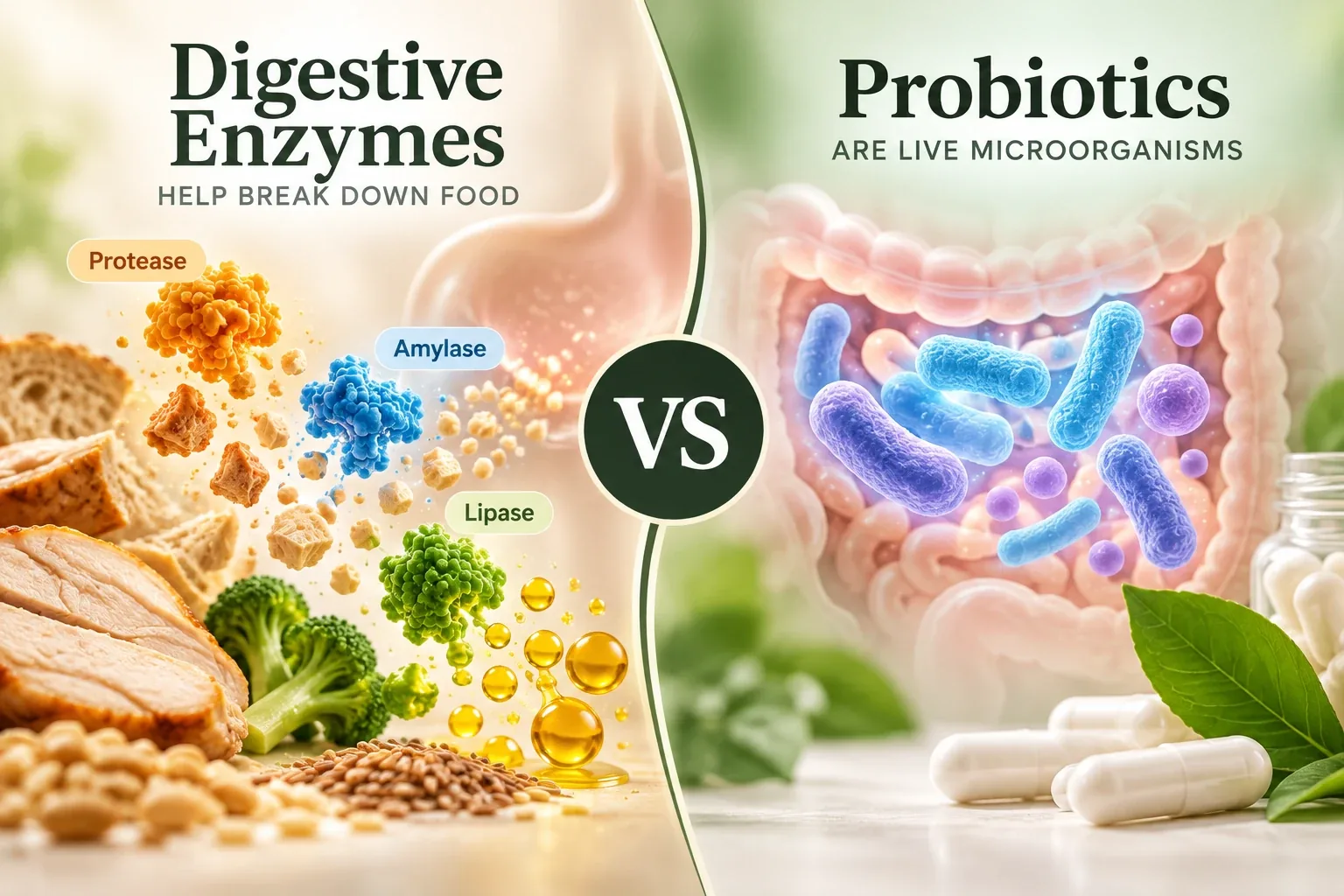
Table of contents
Digestive enzymes and probiotics often come up together when people research bloating, and both are sold as "digestive support" supplements. But they are not the same thing. Digestive enzymes help break down food. Your body makes them, and some supplements contain specific enzymes. Probiotics are live microorganisms intended to have health benefits.
The short answer to "which is better for bloating?" is that neither is universally better. Bloating has many possible causes. The evidence for each category depends on the specific situation and, for probiotics, on the specific strain. This guide explains the differences and what the evidence does and doesn't show.
Digestive Enzymes vs. Probiotics: Quick Comparison
| Digestive enzymes | Probiotics | |
|---|---|---|
| What they are | Substances that break down carbohydrates, fats and proteins in food | Live microorganisms intended to have health benefits |
| Made by your body? | Yes, by the salivary glands, stomach, pancreas and small intestine | No, but your gut naturally contains bacteria that help with digestion |
| Main role | Digesting food into smaller parts | Varies by type; different probiotics may have different effects |
| A well-supported example | Lactase products for lactose intolerance | Possible benefit for overall IBS symptoms, without firm conclusions |
| Key limitation | A specific enzyme acts on a specific food component | Strains aren't interchangeable, and labels haven't always been accurate |
Sources: NIDDK and NCCIH, cited in the sections below.
What Are Digestive Enzymes?
Digestive enzymes are part of normal digestion. According to the National Institute of Diabetes and Digestive and Kidney Diseases (opens in a new tab) (NIDDK):
- Saliva contains an enzyme that begins to break down starches.
- The stomach lining makes stomach acid and enzymes.
- The pancreas makes a digestive juice with enzymes that break down carbohydrates, fats and proteins.
- The small intestine makes digestive juice that mixes with bile and pancreatic juice.
It's important to separate the enzymes your body makes from digestive enzyme products. Some products contain a single enzyme aimed at a specific food component. For example, lactase products contain lactase, the enzyme that breaks down the lactose in milk products. Others combine several enzymes. The authoritative sources we reviewed discuss enzyme products in specific situations, such as lactose intolerance or certain medical conditions, not as something everyone needs.
What Are Probiotics?
According to the National Center for Complementary and Integrative Health (opens in a new tab) (NCCIH), probiotics are "live microorganisms that are intended to have health benefits when consumed or applied to the body." NIDDK describes them as live microorganisms, most often bacteria, that are similar to the microorganisms you normally have in your digestive tract.
"Probiotic" is a broad category rather than a single ingredient. NCCIH notes that different types of probiotics may have different effects. If one specific kind of Lactobacillus helps with a problem, that doesn't necessarily mean another kind of Lactobacillus, or a Bifidobacterium, would do the same. A probiotic's effects depend on which microorganism it contains and the situation it's used for.
Why Does Bloating Happen?
NIDDK describes bloating as "a feeling of swelling or fullness in the abdomen." It's a symptom, not a single disease. According to NIDDK (opens in a new tab), people can have gas symptoms because they have extra gas in the digestive tract, or because they feel gas symptoms more strongly even when the amount of gas is normal.
Common contributors include swallowed air and gas made by bacteria (opens in a new tab) in the large intestine as they break down carbohydrates that weren't digested earlier. NIDDK also lists health conditions that can cause gas symptoms, including:
- irritable bowel syndrome (IBS)
- lactose intolerance
- celiac disease
- small intestinal bacterial overgrowth
- constipation
- gastroparesis
Because the causes vary so much, bloating on its own doesn't indicate an enzyme deficiency or a problem with gut bacteria. For everyday habits that are commonly recommended first, see our guide to practical ways to support digestion and manage occasional bloating.
Can Digestive Enzymes Help With Bloating?
It depends on the cause. The clearest evidence is for specific enzymes in specific situations:
- Lactose intolerance. NIDDK lists bloating and gas among the symptoms of lactose intolerance (opens in a new tab), which happens when the small intestine makes low levels of lactase. According to NIDDK's treatment guidance (opens in a new tab), lactase products, tablets or drops containing lactase, break down the lactose in foods and drinks, lowering the chances of symptoms. NIDDK advises checking with a doctor before using lactase products. Some people, such as young children and pregnant and breastfeeding women, may not be able to use them.
- Medical conditions that affect digestion. For some conditions, such as chronic pancreatitis, NIDDK notes that a doctor may give enzyme pills (opens in a new tab) to help with digestion. That is medical treatment decided by a doctor, not the same as choosing an over-the-counter supplement.
These findings are specific. Lactase helps with lactose, which doesn't mean an enzyme product will help bloating that has a different cause. In the authoritative sources we reviewed, we did not find evidence establishing that general multi-enzyme supplements relieve everyday bloating in people without a specific condition.
Can Probiotics Help With Bloating?
The evidence is mixed and depends on the condition and the probiotic.
- IBS. NCCIH summarizes a 2018 review of 53 studies, which concluded that probiotics "may have beneficial effects on global IBS symptoms and abdominal pain," but that it was not possible to draw definite conclusions about their effectiveness. It was also not possible to identify which species, strains or combinations are most likely to help. NIDDK notes that researchers are still studying probiotics for IBS.
- Bloating specifically. That summary describes overall IBS symptoms and abdominal pain. It doesn't establish that probiotics relieve bloating in general.
Several practical cautions follow from the sources:
- Products aren't interchangeable. Because effects can differ by strain, research on one probiotic doesn't automatically apply to another product.
- Labels haven't always been accurate. NCCIH reports that some probiotic products have been found to contain microorganisms other than those listed on the label.
- Safety has limits too. Probiotics have a history of apparently safe use, particularly in healthy people. However, NCCIH notes that few studies have examined their safety in detail. Serious infections have been reported in premature infants given probiotics.
NCCIH advises consulting a healthcare provider before taking a probiotic supplement, especially if you have health problems.
Digestive Enzymes vs. Probiotics: Key Differences
Although both are marketed for digestive health, they aren't substitutes for each other:
- What they do: enzymes break down food components. Probiotics are living microorganisms whose effects depend on the specific type.
- How specific the evidence is: enzyme evidence is tied to a particular food component, such as lactase for lactose. Probiotic evidence is tied to particular strains and conditions.
- What to look for on a label: for an enzyme product, which enzyme it contains and what it's meant to break down. For a probiotic, the specific strain and amount.
- Their relationship to the body: your body makes its own digestive enzymes. Your gut already contains bacteria that help with digestion.
Choosing between them only makes sense in the context of a specific cause and goal. Without knowing what's behind someone's bloating, neither category can be called the right choice.
Can You Take Digestive Enzymes and Probiotics Together?
We didn't find authoritative guidance that answers this question for everyone. Whether a combination is appropriate depends on the specific products, why they're being used, any medications you take and your health conditions.
NIDDK and NCCIH both recommend talking with a doctor or healthcare provider before using probiotics, and NIDDK recommends the same before using lactase products. NCCIH also notes that some supplements may harm people who have certain conditions or take certain medications. If you're considering taking enzymes and probiotics together, a healthcare professional is the right person to ask.
What to Look for Before Buying a Digestive Supplement
The FDA does not approve dietary supplements (opens in a new tab) for safety and effectiveness before they're sold, so these questions matter. For a fuller framework, see Digestive Health Supplements: What to Look for Before You Buy.
Where Does DigestiStart Fit Into This?
Some readers come to this topic while researching DigestiStart. According to its manufacturer, DigestiStart is a capsule containing a proprietary formula of 11 ingredients, and the manufacturer describes it as supporting "a smooth digestion and a healthy gastrointestinal tract." The ingredients the manufacturer lists are botanicals, such as wild yam and schisandra. The list doesn't name a digestive enzyme or a probiotic strain, so DigestiStart doesn't fit neatly into either category discussed here. We have not seen independent evidence that DigestiStart relieves bloating.
If you're researching the product, our DigestiStart review separates the manufacturer's claims from what we could verify. Our DigestiStart ingredient analysis looks at each listed ingredient. For a product that does list a probiotic, our DigestiStart vs. PrimeBiome comparison shows how the two formulas differ.
When to Talk to a Healthcare Professional
Occasional bloating is common, but some situations call for a professional evaluation rather than a supplement. According to NIDDK (opens in a new tab), talk with your doctor if:
- gas symptoms bother you
- your symptoms change suddenly
- you have other symptoms along with gas, such as abdominal pain, constipation, diarrhea or weight loss
A healthcare professional can help identify the cause, which also determines whether an enzyme, a probiotic or neither is relevant.
The Bottom Line
Digestive enzymes and probiotics are different categories, with different roles in digestion and different evidence. Specific enzymes have clear support in specific situations: lactase products, for example, break down lactose and lower the chances of symptoms in people with lactose intolerance. Probiotics may help some people with IBS symptoms, but the evidence isn't definitive, and results depend on the strain.
Neither is universally better for bloating, because bloating has many possible causes. If bloating is persistent or bothersome, understanding its cause, with a healthcare professional's help when needed, is a better starting point than choosing a supplement category.
Sources & References
- Government health agencyYour Digestive System & How It Works (opens in a new tab). National Institute of Diabetes and Digestive and Kidney Diseases (NIDDK). Accessed September 30, 2026
- Government health agencyDefinition & Facts for Gas in the Digestive Tract (opens in a new tab). National Institute of Diabetes and Digestive and Kidney Diseases (NIDDK). Accessed September 30, 2026
- Government health agencySymptoms & Causes of Gas in the Digestive Tract (opens in a new tab). National Institute of Diabetes and Digestive and Kidney Diseases (NIDDK). Accessed September 30, 2026
- Government health agencyTreatment for Gas in the Digestive Tract (opens in a new tab). National Institute of Diabetes and Digestive and Kidney Diseases (NIDDK). Accessed September 30, 2026
- Government health agencySymptoms & Causes of Lactose Intolerance (opens in a new tab). National Institute of Diabetes and Digestive and Kidney Diseases (NIDDK). Accessed September 30, 2026
- Government health agencyTreatment for Lactose Intolerance (opens in a new tab). National Institute of Diabetes and Digestive and Kidney Diseases (NIDDK). Accessed September 30, 2026
- Government health agencyTreatment for Pancreatitis (opens in a new tab). National Institute of Diabetes and Digestive and Kidney Diseases (NIDDK). Accessed September 30, 2026
- Government health agencyTreatment for Irritable Bowel Syndrome (opens in a new tab). National Institute of Diabetes and Digestive and Kidney Diseases (NIDDK). Accessed September 30, 2026
- Government health agencyProbiotics: Usefulness and Safety (opens in a new tab). National Center for Complementary and Integrative Health (NCCIH), NIH. Accessed September 30, 2026
- Government health agencyUsing Dietary Supplements Wisely (opens in a new tab). National Center for Complementary and Integrative Health (NCCIH), NIH. Accessed September 29, 2026
- Government health agencyDietary Supplements (opens in a new tab). U.S. Food and Drug Administration (FDA). Accessed September 29, 2026
- Manufacturer informationDigestiStart official website (opens in a new tab). Accessed September 30, 2026Used only for the manufacturer's ingredient list and product description. Not independent evidence.
Written by
Wellness Buyer Guide Editorial Team
Editorial team
The Wellness Buyer Guide editorial team researches and writes the articles published on this site.
View profile and articlesRelated Articles
Related Reviews
- DigestiStart Review: Ingredients, Claims, and What to Know Before Buying
A research-based DigestiStart review: listed ingredients, what the manufacturer claims, what we could and couldn't verify, and what to consider before buying.
Related Ingredient Guides
- DigestiStart Ingredients: What’s in the Formula?
See the 11 botanical ingredients DigestiStart's manufacturer lists, what independent sources say about them, and how to read a supplement label before you buy.
Related Wellness Guides
- Probiotics for Bloating: Do They Help? What the Evidence Says
Do probiotics help with bloating? Learn what research says about probiotics, bloating and IBS, possible side effects, and what to check before buying one.
- What Helps With Bloating and Slow Digestion? 7 Practical Ways to Support Better Digestion
Feeling bloated or dealing with slow digestion? Learn practical ways to support digestive health, including fiber, hydration, eating habits, activity, and what to consider before choosing a digestive supplement.
- Digestive Health Supplements: What to Look for Before You Buy
Before buying a digestive health supplement, learn how to read the label, research ingredients, judge probiotic claims and separate marketing from evidence.
- Over-the-Counter Options for Bloating and Gas: What to Know Before You Buy
A guide to over-the-counter options for bloating and gas, including simethicone, lactase, alpha-galactosidase, antacids, fiber and probiotics, and what the evidence shows.